SCF Guide (Supply Chain Financing)
App route: /supply-chain · Verification service category: INS·06 Chain Liquidity (conventional equivalent: supply chain finance)
Read the common steps A to C first (sign in, KYC, fees, how to withdraw).
Prototype vs. sandbox trial. The steps below describe the testnet prototype: the financier role is played by SPANIRA test accounts that load test-token liquidity into a smart contract and pay it out. This product is not active on every test network; on Kaia Kairos the route shows a screen saying Chain Liquidity is not available. In the trial, SCF is planned for a later phase; financing, if any, is decided and provided by the partner institution on its own assessment, after you approve forwarding a referral package to the partner institution you choose. If it finances, the partner institution sets credit limits, the advance and the discount, and pays out the funds from its own account. SPANIRA verifies the documents and checks the anti-double-financing registry. SPANIRA does not lend, does not buy receivables, does not manage investor money and does not offer any return.
Quick summary (1 minute)
- The supplier registers financing at /supply-chain, choosing one of the 6 modes.
- The financier (in the prototype: a SPANIRA test account) pays out an advance → the supplier clicks Tarik dana (withdraw).
- (DeliveryBased mode) Examiners lock the final amount. The buyer pays at maturity.
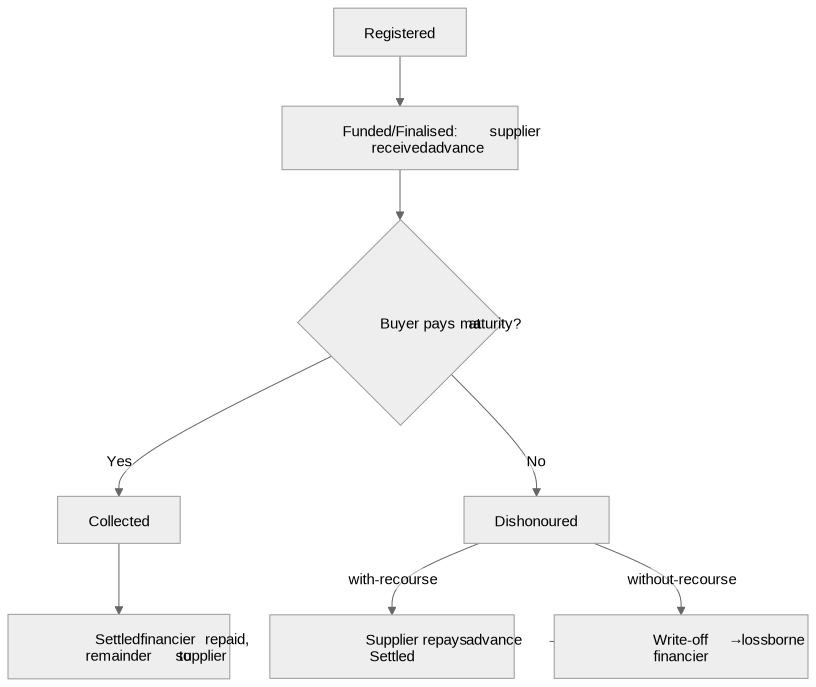
- Settle → the financier recovers the advance plus its discount; the remainder goes to the supplier.
1. What is this product for?
SCF finances the supply chain: the supplier gets funds early, while the large buyer (anchor) only pays at maturity. The gap is bridged by a financier (a three-party model). The prototype has 6 modes for different situations (invoice, PO, reverse factoring, stock, etc.).
Trial scope: in the trial, the Chain Liquidity category (INS·06) covers only invoices already approved by the buyer. The other modes (including PO-based and stock-based financing) exist only in the prototype for technical testing and are not offered in the trial.
Example: Anchor factory B buys components from many small suppliers. So the suppliers don't run short of working capital while waiting 90 days, the financier advances funds today; B repays the financier on day 90.
2. The six financing modes
| # | Mode | Plain meaning | Advance cap in the prototype |
|---|---|---|---|
| 0 | DeliveryBased | Based on delivery evidence (BAST/DO) before a final invoice; the final amount is locked by examiners (m-of-n). | 70% |
| 1 | InvoiceFinancing | Firm invoice (value already fixed); the invoice is the basis for financing. | 85% |
| 2 | ReverseFactoring | Financed on the buyer's creditworthiness (the buyer approves the payable), not the supplier's. | 90% |
| 3 | POFinancing | Based on a Purchase Order (pre-shipment working capital). | 70% |
| 4 | StockFinancing | Based on inventory/stock (warehouse receipt). | 60% |
| 5 | DynamicDiscounting | The buyer pays in full at maturity; the discount is time-based (annual rate). | 85% |
In all modes: the financier funds the advance and the buyer pays at maturity. The caps above are prototype settings; in the trial, the advance is set by the partner institution.
3. Parties involved (3-party)
| Party | Role |
|---|---|
| Supplier (Originator) | Registers the financing and uploads evidence; receives the advance; bears the risk if with recourse. |
| Buyer / Anchor (Counterparty) | The obligor who repays at maturity; subject to a per-obligor credit limit. |
| Financier | In the trial: the partner institution you choose, if it decides to finance. In the prototype: SPANIRA test accounts in the Funder (loads test liquidity), Underwriter (pays out the advance and sets limits) and Attestor (locks the final amount, mode 0) roles. |
4. Prerequisites
- Signed in and business verification approved (supplier and buyer).
- Trigger documents for the mode (BAST/DO, invoice, PO, warehouse receipt, buyer confirmation).
- The buyer's wallet address.
- The buyer is within its per-obligor credit limit. In the prototype, the test financier has loaded liquidity; in the trial, the partner institution you choose decides to finance.
5. Step-by-step flow
| # | Step | Who | What to click (function) | Status |
|---|---|---|---|---|
| 1 | Register the financing (choose a mode) | Supplier | Daftarkan pembiayaan (registerFinancing) (modes 0 to 4) / Daftarkan Dynamic Discounting (registerDynamicDiscount) (mode 5) | Registered |
| 2 | (prototype) the test financier loads liquidity | Funder | fundPool | - |
| 3 | Pay out the advance | Financier | done by the team, not from the customer screens (fundAdvance) | Funded (or directly Finalised in "firm" modes) |
| 4 | Withdraw the advance | Supplier | Tarik dana (withdraw) | Funded |
| 5 | (mode 0) Lock the final amount (m-of-n) | Examiner | finalizeAmount | Finalised |
| 6 | Buyer pays at maturity | Buyer | Approve token ke kontrak → Catat pelunasan (recordCollection) (record collection) | Collected |
| 7 | Settle (split the proceeds) | Anyone | Settle (settle) | Settled |
Key form fields (step 1):
| Field | Plain meaning |
|---|---|
| ID Instrumen (instrument ID) | Financing name/code. |
| Pembeli / Pihak Lawan (buyer) | The buyer's (obligor's) wallet address. |
| Jenis Pembiayaan (financing type) | Pick 1 of the 6 modes above. |
| Nilai estimasi (faceProvisional) (estimated value) | Estimated value; the advance cap = value × the mode's cap. |
| Tenor (hari) (days) | Term until maturity (30/60/90). |
| Recourse | With or without recourse. |
| Referensi bukti (BAST/DO/nomor) + documents | Recorded as a fingerprint and checked against the registry to prevent double financing. |
| Metode Settlement (settlement method) | Choose Settlement Vault (on-chain, otomatis). |
| Annual discount rate (mode 5) | On-screen label: Tingkat diskonto pemberi pembiayaan (%/tahun) [Financer discount rate (%/year)], default 12%. This is a prototype input; in the trial, the discount rate is set by the partner institution. |
6. Worked example
In the trial (proposed fees): financing of Rp100 million (about USD 6,000) falls in the ≤ USD 25,000 band, so the SPANIRA fee is 0.25% = Rp250,000 per transaction whose verification is completed, invoiced directly to the supplier as the business customer. The advance, the discount and any other charges are set and collected by the partner institution.
In the prototype (illustrative figures): InvoiceFinancing mode, value Rp100m, cap 85% → maximum advance 85m. The test financier pays out 80m; the app deducts a 0.5% demo fee → the supplier receives about 79,600,000. At maturity the buyer pays 100m → the financier recovers the advance and its discount, and the remainder goes to the supplier. Mode 5 (DynamicDiscounting): discount = advance × rate × days ÷ 365. E.g. an 80m advance at 12% a year for 90 days ≈ 2.37m.
7. Failure scenarios & credit limit
- Per-obligor credit limit: the financier sets
setObligorCreditLimit(buyer, limit). If a new advance would push the buyer's total debt over the limit, it is rejected (ObligorLimitExceeded). This prevents over-exposure to a single buyer. - Default:
markDishonoured→ with recourse, the supplier repays the advance (exerciseRecourse) → status Settled; without recourse, it is written off (writeOff) and the financier bears the loss. In the prototype the team handles this; supplier and buyer wait for the status update.
SCF statuses: None · Registered · Funded · Finalised · Collected · Settled · Dishonoured · WrittenOff.
8. Mini FAQ
- Which mode should I pick? Firm invoice → InvoiceFinancing; only a PO → POFinancing; want to rely on a large buyer's credit → ReverseFactoring; goods shipped but invoice not final → DeliveryBased; holding stock → StockFinancing; buyer wants a time-based discount → DynamicDiscounting. In the trial, only financing of invoices already approved by the buyer is offered; the other modes are for technical testing in the prototype only.
- Who bears the loss if the buyer defaults? It depends on recourse: the supplier (with) or the financier (without).
- What's "firm" vs "deferred"? Firm = the value is fixed at registration (modes 1 to 5). Deferred = the final value is locked by examiners (mode 0).
- Terms: open /glosarium.