SBLC Guide (Standby Letter of Credit)
App route: /sblc (alias
/commitments/standby) · Verification service category: INS·02 Standby Commitment (conventional equivalent: SBLC)Read the common steps A to C first (sign in, KYC, fees, how to withdraw).
Prototype vs. sandbox trial. The steps below describe the testnet prototype: the applicant deposits test tokens as collateral in a smart contract, and the issuer and claim-examiner roles are played by SPANIRA test accounts. In the trial, with your consent SPANIRA forwards the verification result and a referral package to the partner bank you choose. The bank makes its own assessment and may issue an SBLC on its own decision; it may also decline. If an SBLC is issued, the bank examines any claim against the SBLC terms (ISP98), and the bank decides on and makes the payment. No bank has yet signed a referral cooperation agreement with SPANIRA. Any cash margin the bank asks for follows the bank's terms and is held by the bank, not by SPANIRA. SPANIRA records document fingerprints and runs preliminary checks; it does not issue the SBLC and does not hold funds.
Quick summary (1 minute)
- The applicant fills in the details at /sblc, clicks Ajukan Penerbitan SBLC (request SBLC issuance), then deposits collateral (Izinkan token → Setor jaminan). The issuer (in the prototype: a SPANIRA test account) issues the SBLC.
- As long as everything goes well, no money moves; the SBLC is only a safety net.
- On a default, the beneficiary submits a claim with documents → the claim is examined → the objection window passes → it is paid to the beneficiary.
- If no claim is made before expiry → the collateral returns to the applicant.
1. What is this product for?
An SBLC is a standby guarantee: unlike an ordinary LC, it only pays out if a party fails to meet its obligation (default). If everything runs normally, the SBLC is never drawn; it is simply a safety net. It follows the ISP98 rules.
Example: Supplier B wants assurance that Buyer A will pay. A applies for a USD 500,000 SBLC. If A pays normally, the SBLC expires unused. If A fails to pay, B draws on the SBLC to cover the loss.
Difference from an LC: An LC is a payment tool (pays when documents comply). An SBLC is a guarantee tool (pays only on a failure and a claim). The SBLC also supports partial drawings and an evergreen option (automatic extension).
2. Parties involved
| Party | Role |
|---|---|
| Applicant (Originator) | Requests the SBLC and deposits collateral. |
| Issuer (Underwriter) | In the trial: the partner bank you choose, if the bank decides to issue the SBLC. In the prototype: a SPANIRA test account (UNDERWRITER_ROLE). Issues the SBLC once collateral is in place; extends it if evergreen. |
| Beneficiary (Counterparty) | The party entitled to claim on a default. |
| Claim examiner (Attestor) | In the prototype: a claim-examination committee (m-of-n, default 2). In the trial: the issuing bank's examiners. |
3. Prerequisites
- Signed in and business verification approved (both parties).
- In the prototype: the applicant's test-token balance ≥ the SBLC value (for collateral).
- The beneficiary's wallet address.
- Agree on the value, the expiry date, and whether it is evergreen.
4. Step-by-step flow
| # | Step | Who | What to click (function) | Status |
|---|---|---|---|---|
| 1 | Fill in the SBLC details | Applicant | /sblc, cards Para pihak (parties), Nilai & jangka waktu (value & term), Settlement & dokumen | - |
| 2 | Request issuance | Applicant | Ajukan Penerbitan SBLC | Awaiting processing |
| 3 | Deposit collateral | Applicant | Detail page → Izinkan token → Setor jaminan (vault.deposit) | - |
| 4 | Issue the SBLC | Issuer | from the console (issueStandbyCommitment) | Active (collateral locked) |
| 5 | (normal) no action | - | - | Active |
| 6 | Submit a claim (on default) | Beneficiary | Ajukan Settlement Claim [Submit Settlement Claim] card: enter the claim amount and Ref dokumen (document ref) → Minta Klaim Penyelesaian [Request Settlement Claim] (submitSettlementClaim) | Active (claim pending) |
| 7 | Examine the claim (m-of-n) | Examiner | attestSettlementClaim | (ready once the threshold is reached) |
| 8 | Wait out the objection window (prototype setting, e.g. 2 days) | - | automatic; the applicant may challenge a suspected fraudulent claim on the Klaim settlement [Settlement claims] card: enter the Referensi bukti sengketa (dugaan fraud) [Dispute evidence reference (suspected fraud)] → Sengketakan klaim [Dispute claim] (disputeSettlementClaim) | - |
| 9 | Pay the claim | Anyone | Klaim settlement card → Cairkan klaim [Pay claim] (paySettlementClaim) | Closed (if the value is fully drawn) |
| 10 | Withdraw funds | Beneficiary | Tarik Dana (vault.withdraw) | - |
| 11 | (if no claim) Expire | Applicant | Pengembalian kolateral setelah kedaluwarsa [Return collateral after expiry] card → Tutup SBLC kedaluwarsa [Close expired SBLC] (expireStandbyCommitment) | Expired (collateral returned) |
On networks that use the workflow registry (e.g. Kaia Kairos) the order is: apply from the product page → the team reviews and approves → deposit collateral from the request detail page (Siapkan kolateral) → the SBLC is issued from the console.
Key form fields:
| Field | Plain meaning |
|---|---|
| Referensi instrumen (instrument reference) | SBLC number/name, e.g. "SBLC-500000". It becomes the on-chain ID, so it must be unique. |
| Wallet pihak lawan (penerima klaim) (beneficiary wallet) | Address of the beneficiary entitled to claim. |
| Nominal settlement SBLC (token) (SBLC settlement amount) | Maximum amount guaranteed, in test tokens. |
| Tanggal berakhir (expiry date) | Last day of validity (empty = 365 days). |
| Evergreen | "Yes" = extended automatically by the Periode perpanjangan (hari) (renewal period) for as long as the issuer renews it; "No" = fixed expiry. |
| Metode Settlement (settlement method) | Choose Settlement Vault (on-chain, otomatis). |
| Nilai (Settlement Claim) (claim amount) | Amount drawn under a claim (partial allowed). |
| Ref dokumen (document ref) | Fingerprint of the documents evidencing the default. |
5. Worked example
In the trial (proposed fees): an SBLC of USD 500,000 falls in the above-USD 250,000 band, so the SPANIRA fee is 0.13% = USD 650 (about Rp10.7 million at an assumed Rp16,500/USD) per transaction whose verification is completed, invoiced directly to the business customer. If the bank issues the SBLC, the claim is paid by the bank, not by SPANIRA. The SBLC issuance fee and other bank charges are set and collected separately by the bank.
In the prototype: if the beneficiary draws in full, the app deducts a demo fee of about 0.5% from test tokens (500,000 → the beneficiary receives 497,500 test units). If only 300,000 is drawn, the remaining 200,000 of collateral returns to the applicant when the SBLC expires.
6. Scenarios & flow
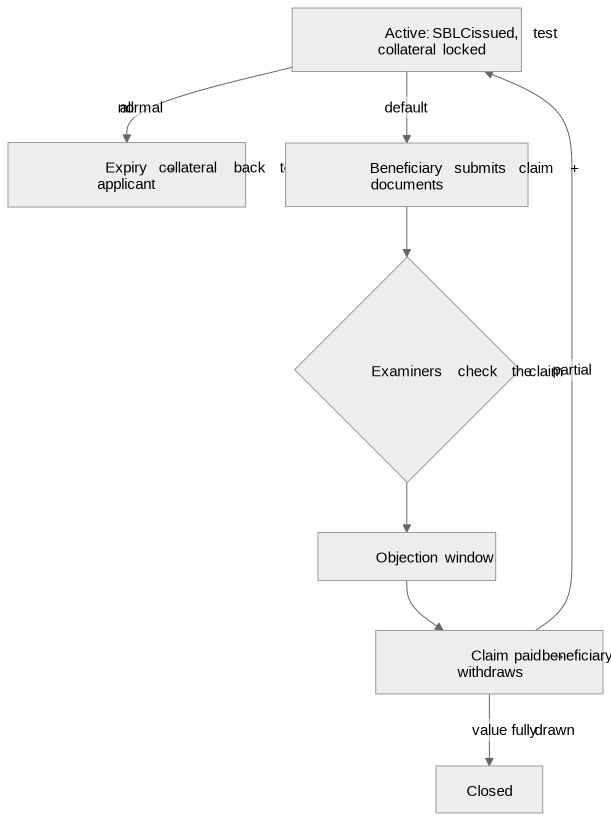
- No claim before expiry (not evergreen): Tutup SBLC kedaluwarsa (
expireStandbyCommitment) → Expired, unused collateral returns to the applicant. - Evergreen: the SBLC is extended as long as the issuer calls
renewbefore expiry; it is stopped with a notice of non-renewal (noticeNonRenewal). - Partial drawing: you may draw several times until the SBLC value is used up.
- Claim button missing: the SBLC is not yet Active, or it has passed its expiry date.
SBLC statuses: None · Active · Expired · Closed.
7. Mini FAQ
- When does an SBLC pay out? Only when a default claim is found to meet the SBLC terms. In the prototype, the claim is checked by m-of-n examiners and goes through the objection window. In the trial, the decision and the payment rest with the issuing bank; SPANIRA does not promise any payment timing.
- What is the objection window? A pause after a claim is approved (e.g. 2 days in the prototype), giving the other party time to object before funds are paid.
- What is evergreen? An SBLC that extends itself; useful for long-term contracts. The renewal (
renew) must happen before the expiry date. - Terms: open /glosarium.