L/C Guide (Letter of Credit)
App route: /lc (alias
/commitments/documentary) · Verification service category: INS·01 Documentary Commitment (conventional equivalent: L/C)Read the common steps A to C first (sign in, KYC, fees, how to withdraw).
Prototype vs. sandbox trial. The steps below describe the testnet prototype: the buyer deposits test tokens as collateral in a smart contract, and the issuer and document-examiner roles are played by SPANIRA test accounts. In the trial, with your consent SPANIRA forwards the verification result and a referral package to the partner foreign-exchange bank you choose. The bank makes its own assessment and may issue an L/C on its own decision; it may also decline. If an L/C is issued, the bank's examiners check the documents under UCP 600 and ISBP, and the bank decides whether they comply and makes the payment. No foreign-exchange bank has yet signed a referral cooperation agreement with SPANIRA. Any cash margin the bank asks for follows the bank's terms and is held by the bank, not by SPANIRA. SPANIRA provides the application portal, records document fingerprints (hashes) on the blockchain, runs automated preliminary checks, offers an examiner portal for the bank, and keeps the anti-double-financing registry. SPANIRA does not issue the L/C and does not hold funds.
Quick summary (1 minute)
- The buyer fills in the form at /lc, clicks Ajukan Penerbitan (request issuance), then deposits collateral (Izinkan token → Setor jaminan). The issuer (in the prototype: a SPANIRA test account) issues the L/C.
- The seller ships the goods, then clicks Kirim Pengajuan Bukti (submit evidence) with the invoice, B/L, etc.
- The examiners (2 different checkers) check the documents → Verified.
- Click Cairkan Pembayaran (release payment) → funds land in the seller's balance → the seller clicks Tarik Dana (withdraw). Done.
1. What is this product for?
A Letter of Credit (L/C) is a promise to pay against documents: the seller is paid after presenting documents that comply with the terms (under UCP 600). It suits export-import trade where the buyer wants proof the goods were actually shipped before paying, and the seller wants certainty of payment when the documents are in order.
Example: Importer A (Indonesia) buys USD 190,302 of textiles from exporter B (Vietnam). A applies for an L/C; B is paid only after presenting a Commercial Invoice, Bill of Lading and Certificate of Origin that match the L/C terms.
2. Parties involved
| Party | Role |
|---|---|
| Buyer / applicant (Originator) | Importer; requests the L/C and deposits collateral. |
| Seller / beneficiary (Counterparty) | Exporter; presents documents and receives payment. |
| Issuer and examiner (Issuer + Checker) | In the trial: the partner foreign-exchange bank you choose, if the bank decides to issue the L/C; that bank also examines the documents. In the prototype: SPANIRA test accounts (ISSUER_ROLE, CHECKER_ROLE, m-of-n). |
3. Prerequisites
- Signed in and business verification approved.
- In the prototype: the buyer's test-token balance ≥ L/C value + tolerance (for collateral).
- The seller's wallet address.
- Agreed terms: value, tolerance ±%, expiry date, latest shipment date, list of required documents, payment terms (at sight or usance 30/60/90 days), Incoterms.
4. Step-by-step flow
| # | Step | Who | What to click (function) | Status |
|---|---|---|---|---|
| 1 | Fill in the L/C details | Buyer | /lc, sections Para pihak (parties), Nilai & pembayaran (value & payment), Pengiriman & jangka waktu (shipment & timeline), Dokumen wajib (required documents) | - |
| 2 | Request issuance | Buyer | Ajukan Penerbitan (request saved, nothing on-chain yet) | Awaiting processing |
| 3 | Deposit collateral (value + tolerance) | Buyer | Detail page → Izinkan token → Setor jaminan (vault.deposit) | - |
| 4 | Issue the L/C | Issuer | from the console (createCommitment) | Active (collateral locked) |
| 4b | (optional) Amend terms | Issuer proposes, seller accepts/rejects | 2b. Amendment (UCP Art.10) card: Terima (Pihak Lawan) [Accept (Counterparty)] / Tolak (Pihak Lawan) [Reject (Counterparty)] / Batalkan usulan (Originator/Pihak Lawan) [Cancel proposal (Originator/Counterparty)] (proposeAmendment → acceptAmendment/rejectAmendment/withdrawAmendment) | still Active |
| 5 | Ship the goods, then present the documents (this round's drawing amount) | Seller | Kirim Pengajuan Bukti (submitEvidence) | EvidenceSubmitted |
| 6 | Examine the documents (2 different checkers) | Examiner | recordVerification(true) | Verified |
| 7 | Release payment for this round | Anyone | Cairkan Pembayaran (authorizeSettlement) | Settled if final drawing; otherwise back to Active for the next round |
| 8 | Withdraw funds | Seller | Tarik Dana (vault.withdraw) | Settled |
On networks that use the workflow registry (e.g. Kaia Kairos) the order differs slightly: apply from the product page → the team reviews and approves → deposit collateral from the request detail page (Siapkan kolateral) → the L/C is issued from the console.
4b. Amendment (UCP Art.10) and partial/multi-drawing (added in Fase 3)
"Fase 3" here is a prototype development stage, not a phase of the sandbox trial.
- Amendment: while the L/C is still Active (no presentation in progress), the issuer can propose a change to the amount, expiry, latest shipment, tolerance or required documents via
proposeAmendment. If the amount goes up, the extra collateral is locked from the buyer's free balance at proposal time (not at acceptance), so the funds are there before the seller decides. The seller then accepts (acceptAmendment; the new terms apply and any decrease is released immediately) or rejects (rejectAmendment; any reserved increase is released back). The buyer or the seller (click Batalkan usulan (Originator/Pihak Lawan) on card 2b), or the issuer from the console, can withdraw a pending proposal (withdrawAmendment). The buyer or seller address cannot be changed by amendment; the L/C has to be cancelled and reissued (as in bank practice). - Partial/multi-drawing: when presenting, the seller enters the Jumlah presentasi (drawAmount) [Presentation amount], the actual invoice or shipment value for this round (it may be less than the L/C value, covering short shipment or under-invoicing), and Drawing terakhir? [Final drawing?]. If the L/C was issued with Partial shipment = No, only one drawing is permitted, it must be marked final, and its amount must be within the tolerance band. If Partial shipment = Yes, the seller can present several drawings over several rounds, cumulatively, until one is marked final or the collateral is fully drawn. After a non-final drawing is paid, the L/C returns to Active so the seller can present the next round. On the final drawing, any unused collateral (including unused tolerance headroom) returns to the buyer automatically.
4c. Assignment of proceeds (UCP Art.39) and revolving commitment (added in Fase 4)
"Fase 4" here is also a prototype development stage, not a phase of the sandbox trial.
- Assignment of proceeds: once a drawing round reaches Verified, the seller can open the 4d assign-proceeds card, enter the Alamat penerima baru (wajib KYC) [New recipient address (KYC required)] and click Assign proceeds (
assignProceeds(newPayee)) to redirect this round's payment only to a third party (e.g. the seller's own bank). The new payee must already have passed verification. This transfers only the right to the payment (UCP 600 Art.39), not the L/C itself: the original seller still presents the documents for every round, and the assignment lapses automatically once that round is paid. For a later round, the assignment has to be made again. - Revolving L/C: an L/C can be issued with
revolvingCycles > 0(0 = not revolving). Once a cycle reaches Settled, the issuer or the buyer can open the next cycle from the 6. Revolving — buka siklus baru [open a new cycle] card (enter Expiry siklus baru and Latest shipment siklus baru, click Reinstate cycle;reinstateCycle(newExpiry, newLatestShipment)). This reduces the cycles remaining, advances the cycle number, resets the drawing state to fresh (Active), and re-locks the same value + tolerance as a new issuance, so the buyer needs enough free balance in the vault. Each cycle has its own expiry and latest shipment dates. Term changes between cycles (value, tolerance, required documents) use the amendment flow above once the cycle is back to Active;reinstateCycleonly resets drawing progress and re-locks collateral.
Key form fields (step 1):
| Field | Plain meaning |
|---|---|
| Referensi Komitmen (→ id) (commitment reference) | L/C name/number, e.g. "LC-A-B-001". It becomes the ID, so it must be unique. |
| Pihak Lawan / Payee (counterparty) | The seller's wallet address. |
| Mata uang (currency) and Nilai transaksi (transaction value) | Value per the documents or the parties' agreement, e.g. USD 190,302. Recorded for information. |
| Metode Settlement (settlement method) | Choose Settlement Vault (on-chain, otomatis). |
| Nominal settlement (token) (settlement amount) | Maximum L/C value in test tokens, used for payment and collateral, e.g. 190,302. |
| Pembayaran (usance) (payment) | At sight (0 days) or deferred 30/60/90 days (paid at maturity). |
| Toleransi jumlah (%) (amount tolerance) | Allowed variance in value (UCP 600 Art.30), default 5%. |
| Incoterms, Uraian barang (goods description), Pelabuhan muat (port of loading), Pelabuhan tujuan (port of destination), Partial shipment, Transshipment | Trade data per the documents and the parties' agreement. Partial shipment decides whether staged drawings are allowed. |
| Tanggal expiry (expiry date) | Last day to present documents (empty = 45 days). |
| Pengiriman terakhir (latest shipment) | Last day the goods may be shipped (empty = 21 days). |
| Bukti wajib (required evidence; section Dokumen wajib) | Document checklist (Invoice, B/L, COO, Packing List, etc.). |
5. Worked example
In the trial (proposed fees): an L/C of USD 190,302 falls in the over USD 100,000 to 250,000 band, so the SPANIRA fee is 0.25% = USD 475.76 (about Rp7.85 million at an assumed Rp16,500/USD) per transaction whose verification is completed, invoiced directly to the business customer. If the bank issues the L/C, the seller is paid by the bank, not by SPANIRA. The L/C commission and other bank charges are set and collected separately by the bank. For 60-day usance, the bank pays on the maturity date.
In the prototype: the Perkiraan biaya penerbitan Komitmen Dokumenter (Documentary Commitment issuance fee estimate) box shows a demo fee of about 0.5%, deducted from test tokens at payout (USD 190,302 → the seller receives 189,350.49 test units). Usance payouts can only be released after the maturity date.
6. Failure / document-discrepancy scenarios
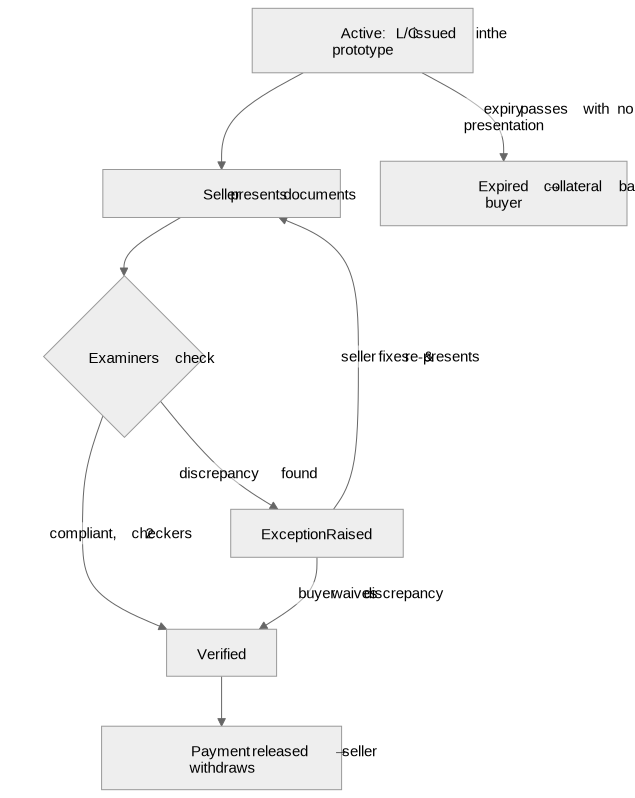
- Non-compliant documents (discrepancy): a single "not compliant" finding from an examiner (
recordVerification(false)) → status ExceptionRaised. The seller can fix the documents and click Presentasi ulang dokumen (re-present documents), or the buyer reviews the findings item by item on the 4b. Originator — tinjau temuan per-item (review individual findings) card and accepts the discrepancy with Waive Exception (a UCP practice) → proceeds to Verified. In the trial, discrepancies and any waiver follow the issuing bank's decision. - Expiry passes with no presentation: anyone can call
expireCommitment→ status Expired, collateral returns to the buyer (the seller is not paid). - Usance not yet due: payment is refused until the maturity date.
L/C statuses: None · Active · EvidenceSubmitted · Verified · ExceptionRaised · Settled · Expired · Cancelled.
7. Mini FAQ
- "At sight" vs "usance"? At sight = paid as soon as the documents are found compliant. Usance = paid later (e.g. 60 days) after the documents are found compliant.
- Can I check documents before presenting them? Yes, at /cek-dokumen. It is a preliminary check; the bank's examiners decide compliance.
- Why does examination need several examiners? So no single person decides alone. The prototype requires 2 different checkers; in the trial, examination follows the issuing bank's procedures.
- Terms: open /glosarium.