Factoring Guide (Receivables Financing)
App route: /factoring (alias
/liquidity/receivables) · Verification service category: INS·05 Receivables Liquidity (conventional equivalent: receivables financing/factoring)Read the common steps A to C first (sign in, KYC, fees, how to withdraw).
Prototype vs. sandbox trial. The steps below describe the testnet prototype: the financier role is played by a SPANIRA test account that pays out test tokens from a smart contract. In the trial, with your consent SPANIRA forwards the invoice verification result as a referral package to the partner BPR/BPRS or bank you choose. The partner institution makes its own assessment and may finance through an assignment of receivables, or decline. If it finances, the partner institution sets the advance, the discount or fee and the recourse terms, and pays out the funds from its own account. No BPR/BPRS or bank has yet signed a referral cooperation agreement with SPANIRA. SPANIRA verifies the invoice and checks the anti-double-financing registry. SPANIRA does not buy receivables, does not lend, does not manage investor money and does not offer any return.
Quick summary (1 minute)
- The seller registers an invoice at /factoring by clicking Daftarkan Piutang (register receivable).
- The financier (in the prototype: a SPANIRA test account) pays out an advance → the seller clicks Tarik Dana (withdraw) to receive the cash early.
- At maturity, the obligor (buyer) pays in full on the Obligor — bayar saat jatuh tempo [Obligor — pay at maturity] card: click Approve token ke kontrak [Approve token for contract], then Bayar sebagai Obligor (counterpartyPay) [Pay as Obligor].
- The payment is split: principal and discount to the financier, the remainder (retention) to the seller.
1. What is this product for?
Factoring means cashing in an invoice early. A seller holding an invoice that falls due later (e.g. in 60 days) can get an advance now from a financier instead of waiting for the buyer to pay. It is a three-party model: the financier bridges the gap, and the buyer still pays at maturity.
Example: Supplier A sells Rp100 million of goods to Distributor B on 60-day terms. A needs working capital now. A applies for financing against the invoice; the financier advances funds today. At 60 days, B pays Rp100 million; the financier recovers the advance plus its discount, and A receives the rest.
2. Parties involved (3-party)
| Party | Role |
|---|---|
| Seller / Supplier (Originator) | Registers the invoice; receives the advance now; bears the risk if with recourse. |
| Obligor / Buyer (Counterparty) | Owes the invoice; pays in full at maturity. |
| Financier | In the trial: the partner BPR/BPRS or bank you choose, if it decides to finance. In the prototype: a SPANIRA test account (Funder/Underwriter role). Sets the advance and discount, pays out the advance, and receives the repayment. |
3. Prerequisites
- Signed in and business verification approved (seller and obligor).
- A valid invoice with trigger documents (delivery note/BAST, invoice and reconciliation, PO/contract).
- The obligor's wallet address.
- In the prototype: the test financier has provided test-token liquidity. In the trial: the partner institution you choose decides to finance.
4. Step-by-step flow
| # | Step | Who | What to click (function) | Status |
|---|---|---|---|---|
| 1 | Register the receivable (fill in the form) | Seller | Daftarkan Piutang (registerReceivable) | Registered |
| 2 | Pay out the advance | Financier | done by the team, not from the customer screens (fundReceivable(advance, discount)) | Funded |
| 3 | Withdraw the advance to wallet | Seller | Tarik Dana (withdraw) | Funded |
| 4 | Obligor pays in full at maturity | Obligor | Obligor — bayar saat jatuh tempo card → Approve token ke kontrak → Bayar sebagai Obligor (counterpartyPay) (transfers the invoice value) | Paid |
| 5 | Automatic split, then withdraw the remainder | Seller | Tarik Dana (withdraw) | Paid |
Key form fields (step 1):
| Field | Plain meaning |
|---|---|
| ID Instrumen (instrument ID) | Receivable name/code. |
| Pihak tertagih / Obligor (Pihak Lawan) (obligor) | Wallet address of the party who must pay. |
| Nilai tagihan (invoice value) | Full invoice value. The advance is set by the financier at payout, not when you register. |
| Jatuh tempo (obligor bayar) (maturity) | When the obligor pays (e.g. 30/40/60 days). |
| Recourse | With recourse (factoring) = the seller bears the loss if the obligor defaults; without recourse (forfaiting) = the financier bears it. |
| No. Invoice + trigger documents | Recorded as a fingerprint and checked against the registry so the same invoice cannot be financed twice. |
| Metode Settlement (settlement method) | Choose Settlement Vault (on-chain, otomatis). |
5. Worked example
In the trial (proposed fees): an invoice of Rp100,000,000 (about USD 6,000) falls in the ≤ USD 25,000 band, so the SPANIRA fee is 0.25% = Rp250,000 per transaction whose verification is completed, invoiced directly to the seller as the business customer. The advance, the discount or fee, and any other charges are set and collected by the partner institution.
In the prototype (illustrative figures): invoice value 100,000,000 test units, advance 70% = 70,000,000, discount 10,000,000. The app deducts a 0.5% demo fee from the advance → the seller receives about 69,650,000 up front. When the obligor pays 100,000,000:
- Test financier: 80,000,000 (70m advance + 10m discount; in the prototype part of the discount is allocated to a bank role as ujrah)
- Seller (retention/remainder): 20,000,000
6. Failure scenario (obligor defaults)
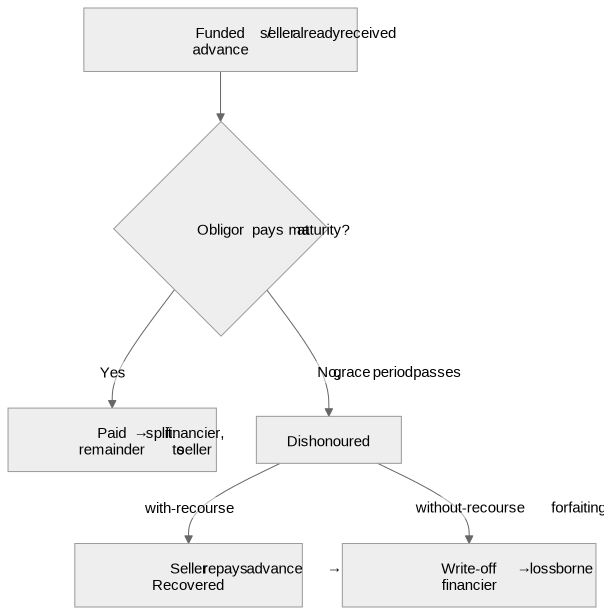
- With recourse: the financier marks the receivable as dishonoured (
markReceivableDishonoured), then the seller repays the advance (exerciseRecourse) → Recovered. The seller bears the risk. The prototype has no recourse button on the customer screens yet; contact the SPANIRA team. - Without recourse (forfaiting): the receivable is written off (
writeOff) → WrittenOff. The financier bears the loss.
Factoring statuses: None · Registered · Funded · Paid · Dishonoured · Recovered · WrittenOff.
7. Mini FAQ
- Why isn't the advance 100%? It is a risk margin (borrowing base); the rest is paid to the seller once the obligor settles. The financier sets it (in the trial, the partner institution).
- What is ujrah? The fee paid to a BPRS under a sharia contract. In the trial, the partner BPRS sets it, not SPANIRA.
- With or without recourse? With = if the buyer defaults, the seller repays the advance. Without = the financier bears the loss (usually at a higher price).
- Does SPANIRA provide the financing? No. SPANIRA verifies the invoice and checks the registry; financing, if any, is decided and provided by the partner institution on its own assessment.
- Terms: open /glosarium.