Escrow Guide (Conditional Settlement)
App route: /escrow (alias
/settlements/conditional) · Verification service category: INS·04 Conditional Settlement (conventional equivalent: conditional escrow)Read the common steps A to C first (sign in, KYC, fees, how to withdraw).
Prototype vs. sandbox trial. The steps below describe the testnet prototype: the buyer locks test tokens in a smart contract on a test network to demonstrate vault mode, and the app releases them to the seller once the evidence is accepted. No real money is used. In the trial, the parties choose a settlement path. On the referral path, SPANIRA verifies the documents showing the conditions are met, and the buyer then pays in Rupiah through their bank into the seller's bank account (or through an escrow account of the partner institution if the parties use that bank's escrow product); the money never passes through SPANIRA. In Crypto Asset Settlement (from Phase II, if approved and once prerequisites are met), crypto assets are locked in a smart contract and released only under the coded conditions or returned to the depositor (vault mode), or held in one account at PT Tennet Depository Indonesia in SPANIRA's name for the benefit of its customers (omnibus); your balance is recorded separately and reconciled daily, and Tennet verifies and approves every instruction (custodian mode). SPANIRA does not hold your money. Assets are released only under the contract conditions or returned to the depositor; the emergency release function can only send assets to the verified wallet of the depositor or the recipient, through multisignature and a 48-hour timelock (applied before Phase II; on the test-network prototype this function is still held by a SPANIRA team admin key).
Quick summary (1 minute)
- The buyer opens /escrow, fills in the form, clicks Ajukan escrow (submit escrow), then on the detail page clicks 1. Izinkan token (approve token) and 2. Kunci dana (lock funds); the test tokens are locked.
- The seller ships the goods, then on the Bukti escrow dan pemeriksaan (escrow evidence and review) card chooses Jenis pengajuan (submission type) = Bukti pengiriman / tahap pembayaran (shipment / payment stage evidence), uploads the documents, clicks Siapkan pengajuan (prepare submission), then Kirim bukti tahap (submit stage evidence). The buyer reviews it and clicks Terima bukti & rilis (accept evidence & release) → that stage's value lands in the seller's balance.
- The seller clicks Tarik pembayaran (withdraw payment) → test tokens move to the wallet. Done.
- If the goods don't arrive by the deadline → the buyer clicks Minta Pengembalian Dana (request refund) → the test tokens return.
1. What is this product for?
Conditional settlement (escrow) arranges for payment to be made only once the agreed conditions are shown to be met (for example, the goods arrive). SPANIRA verifies the documents that evidence those conditions. It solves the "chicken-and-egg" problem: the seller won't ship without certainty of payment, and the buyer won't pay before the goods arrive. In the trial, the buyer still pays in Rupiah through their bank into the seller's bank account.
Example: Shop A buys a Rp100 million machine from Factory B, a first-time counterparty. They agree that A pays once the machine is received. B ships the machine and uploads the signed handover report. Once SPANIRA has verified the handover report, A pays B through the bank.
2. Parties involved
| Party | Role |
|---|---|
| Buyer (Payer) | In the prototype: locks test tokens; accepts or rejects the seller's stage evidence; requests a refund once the deadline passes. In the trial: pays the seller through the bank once the conditions are verified. |
| Seller (Payee) | Ships the goods, submits evidence for each stage, and receives payment. |
| Arbiter | Neutral party for disputes. In the prototype the arbiter field may be left empty, in which case the platform's fallback arbiter is used. In the trial, every escrow must name an arbiter agreed by the parties; SPANIRA's fallback arbiter role is removed before Phase II. |
| Parties' banks / custodian (trial) | On the referral path, the buyer's bank pays the seller's bank. In custodian mode, the custodian verifies and approves every release or refund instruction. In the prototype, a test-network smart contract demonstrates this role. |
3. Prerequisites
- Signed in (
/signin) and business verification approved (/onboarding); see common steps. - In the prototype: the buyer's wallet holds a test-token balance ≥ the transaction value.
- You know the seller's wallet address (payee).
- Agree on a deadline, an arbiter, and a description of the deal or its milestones.
4. Step-by-step flow (prototype)
| # | Step | Who | Where / what to click | Resulting status |
|---|---|---|---|---|
| 1 | Fill in the form (fields below) | Buyer | /escrow, sections Para pihak (parties), Nominal & tenggat (amount & deadline), Kesepakatan & settlement | - |
| 2 | Save the request | Buyer | Ajukan escrow button (saved, tokens not yet locked) | - |
| 3 | Approve the token, then lock | Buyer | Detail page → 1. Izinkan token → 2. Kunci dana (openConditionalSettlement) | Funded (test tokens locked) |
| 4 | Ship the goods, then submit stage evidence (documents + stage amount) | Seller | Bukti escrow dan pemeriksaan card: Jenis pengajuan = Bukti pengiriman / tahap pembayaran, fill in Referensi pengajuan (submission reference) and Nominal tahap (token settlement) (stage amount), upload documents → Siapkan pengajuan → Kirim bukti tahap | Funded (evidence awaiting decision) |
| 5 | Accept the evidence and release that stage, or reject it with a reason | Buyer | Accept: Terima bukti & rilis. Reject: Jenis pengajuan = Tolak bukti tahap (reject stage evidence), fill in Alasan (reason) → Siapkan pengajuan → Tolak bukti dengan alasan (reject evidence with a reason) | Released once everything is released; otherwise still Funded |
| 6 | Withdraw to wallet | Seller | Tarik pembayaran button (withdraw) | Released |
| 7 | Done | - | - | Released |
Older escrows created under the direct-release rule don't use stage evidence: the buyer enters a Jumlah rilis (release amount; empty = everything left) and clicks Cairkan ke Penerima (release to recipient) (executeSettlementByPayer).
Form fields (step 1):
| Field | Plain meaning |
|---|---|
| Referensi (reference) | Deal name/code, e.g. "ESCROW-A-B-001". It becomes the escrow ID, so it must be unique. |
| Pihak Lawan / Payee (wallet penerima) (receiver wallet) | The seller's wallet address. |
| Arbiter (opsional) (optional) | The mediator's address. In the prototype, empty = the platform's fallback arbiter. In the trial, an arbiter agreed by the parties must be entered. |
| Stablecoin | The test token used in the prototype. In the trial, the referral path uses no stablecoin. In Crypto Asset Settlement (from Phase II, conditional), the assets used are IDRP, or USDC/USDT for cross-border transactions only. |
| Nilai transaksi (transaction value) | Value to lock, e.g. 100,000. |
| Deadline (hari; 0=tanpa) (days; 0 = none) | Time limit; 0 = no limit. Past the deadline the buyer may request a refund. |
| Deskripsi kesepakatan / milestone (deal description) | Terms or stages, e.g. "Release 50% on arrival, 50% after inspection". Stored as a fingerprint (termsHash). |
| Metode Settlement (settlement method) | Choose Settlement Vault (on-chain, otomatis). |
5. Worked example
In the trial (proposed fees): an escrow of Rp100,000,000 (about USD 6,000) falls in the ≤ USD 25,000 band, so the SPANIRA fee is 0.25% = Rp250,000 per transaction whose verification is completed, billed to the buyer as the business customer. On the referral path it is invoiced directly; in vault mode the smart contract deducts it on release; in custodian mode it is subtracted from the transfer instruction amount. Each bank sets its own charges separately.
In the prototype: the screen shows a Perkiraan fee escrow (escrow fee estimate) and deducts a 0.25% demo fee from the released test tokens (100,000 units → the seller receives 99,750 units). Refunds to the buyer carry no demo fee.
6. Failure / dispute scenarios
The diagram below describes the prototype.
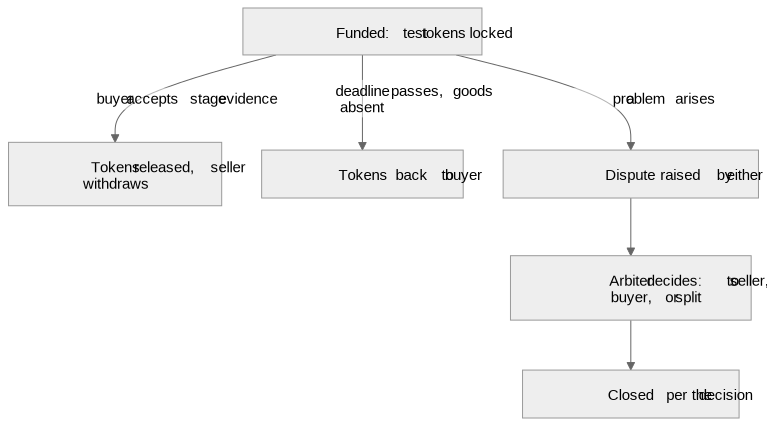
- Goods don't arrive / deadline passes: the buyer clicks Minta Pengembalian Dana (
refundAfterDeadline) → status Refunded, then withdraws with Tarik pengembalian dana (withdraw refund). If the deadline is 0 there is no automatic refund; the tokens stay locked until released or decided by the arbiter. - Dispute: the buyer or the seller opens the Bukti escrow dan pemeriksaan card, chooses Jenis pengajuan = Bukti sengketa (dispute evidence), fills in Alasan (reason) and uploads documents, clicks Siapkan pengajuan, then Ajukan sengketa dengan bukti (submit dispute with evidence) (
raiseSettlementDispute) → status Disputed, tokens frozen. If that card is not yet available on your network, the Sengketa (dispute) card asks you to contact the operator. The arbiter decides the split (resolveSettlementDispute): to the seller, to the buyer, or divided. In the prototype, the fallback arbiter's decision is executed by the SPANIRA team from the operations console. In the trial, on the referral path the buyer pays the seller through their bank according to the decision; in vault mode the decision is executed by the smart contract, and in custodian mode by the custodian after it verifies the instruction. - Staged release: the value can be released stage by stage; status stays Funded until everything is released (then Released).
Escrow statuses: None · Funded · Released · Refunded · Disputed · Closed.
7. Mini FAQ
- Where is my money during the transaction? In the prototype there is no money: test tokens are locked in a test-network smart contract and can only leave by release to the seller, refund to you, or an arbiter decision. In the trial, on the referral path your money stays at your bank until you pay the seller through it; SPANIRA never holds it. In Crypto Asset Settlement (from Phase II, conditional), the assets are locked in a smart contract (vault mode) or held in the omnibus account at the custodian (custodian mode). Assets are released only under the contract conditions or returned to the depositor; the emergency function can only send to the verified wallet of the depositor or the recipient, through multisignature and a 48-hour timelock (applied before Phase II). If the trial is stopped, assets are released or returned under the contract rules or the custodian's per-customer records.
- Can I skip the arbiter? In the prototype the arbiter field may be left empty and the platform's fallback arbiter is used. In the trial, every escrow must name an arbiter agreed by the parties; SPANIRA's fallback arbiter role is removed before Phase II.
- Why "Withdraw" again? That is how the prototype works: the receiver pulls their own balance from the smart contract. In the trial, on the referral path the buyer pays directly through the bank into the seller's account.
- Terms: open /glosarium.